NEWS
JAPAN: SAKE HOUSES PIVOT TO WHISKY AMID FLATLINING SAKE SALES
By Staff Reporter
11-11-2026
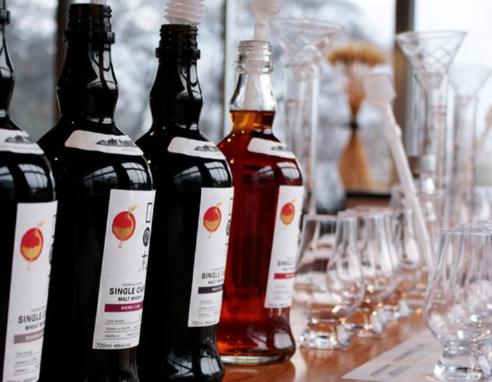
Source: Kiuchi Brewery
Long-established Japanese sake producers are building new whisky distilling capacity and launching malt expressions, pivoting to whisky as a high-margin export engine while domestic sake consumption remains flat.
Many are experimenting beyond barley, introducing locally grown rice and wheat into their grain bills to create flavour profiles that set them apart from established Suntory and Nikka labels.
Kiuchi Brewery, a 200-year-old Ibaraki sake house, is among the most prominent examples. It sources more than half of its raw materials locally and now ships its Hinomaru whisky to roughly 20 markets.
For generations focused on rice fermentation and koji culture, these family-run breweries are repurposing deep fermentation expertise to craft distinctive Japanese whisky, targeting buyers across Southeast Asia, the United States and South Korea.
The firm has laid out plans to grow its whisky revenue substantially over the next decade, treating the category as a separate long-term growth pillar alongside its core sake lines.
Other makers including Niigata’s Hakkaisan and Tochigi’s Nishibori Shuzo have followed suit; Nishibori’s TETSU whisky uses sake yeast, transferring centuries of rice-fermentation know-how directly into whisky washes.
The expansion is fuelled by Japan’s extraordinary whisky export trajectory. Official data shows export value has multiplied roughly 29 times over 15 years, even as many domestic sake volumes slowly decline.
Whisky’s global collector culture and premium pricing offer a compelling hedge for brewers grappling with ageing local drinker demographics and stagnant homemmarket sales.
Yet the shift carries notable risks. Whisky requires years of cask maturation before it can be sold, tying up capital for extended periods.
Industry insiders warn that the wave of new entrants is crowding the mid-tier craft whisky segment, and not every new distillery project will survive the long wait for matured stock.
The ongoing public consultation over statutory Japanese whisky G.I. labelling rules adds another layer of uncertainty.
Proposed binding production standards could reshape what may legally carry the “Japanese whisky” name, imposing compliance costs that fall heavier on smaller, newly built distilleries.
Trade observers say the trend is more than a passing fad. It represents a creative reimagining of Japan’s drinks heritage: sake brewers are not simply copying Scottish malt conventions, but building whisky that carries the aroma, water and fermentation logic of Japanese rice brewing.
(the writer can be contacted at: info@thewinechronicle.com)
ALL RIGHTS RESERVED
**IF YOU THINK THE WINE CHRONICLE IS WORTH SUPPORTING, PLEASE MAKE A DONATION TO HELP US IMPROVE AND CONTINUE OUR WORK**
TRENDING│ FOCUS│ MISSION│ ABOUT US│ CONTACT
|